
PAS violated the Constitution. The Constitutional Court proved us right
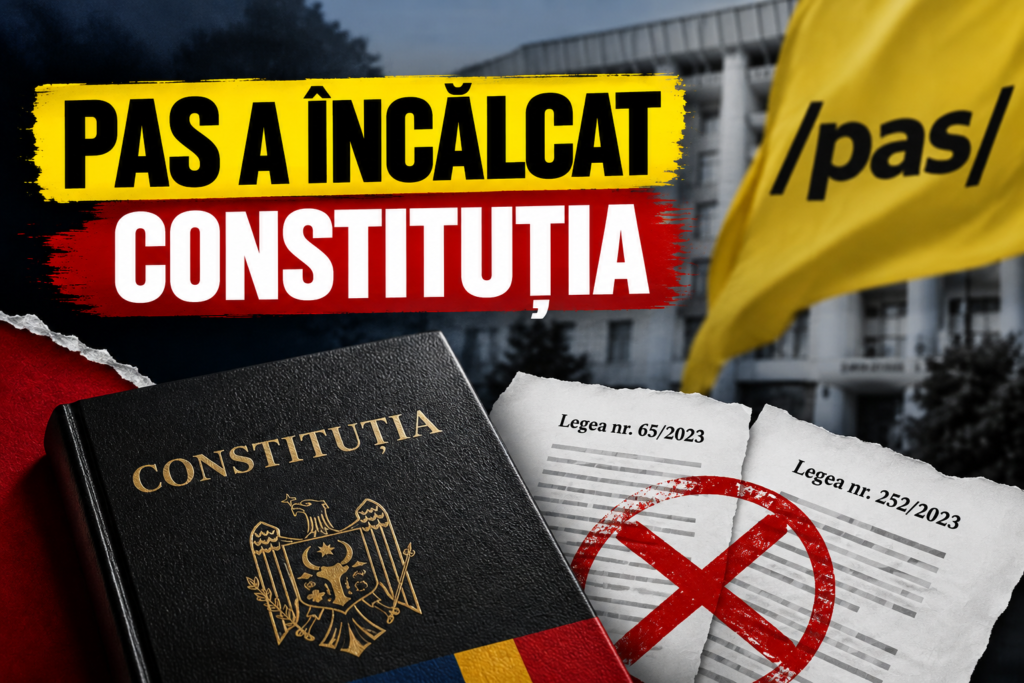
The Constitutional Court has upheld the opposition’s referral and declared unconstitutional the provisions by which the PAS majority lowered the voting threshold for appointing members of the external evaluation commissions for judges and prosecutors. Among the authors of the referral is Democracy at Home MP Alexandru Verșinin.
Chișinău, 15 October 2026
On 15 October 2026, the Constitutional Court of the Republic of Moldova upheld referral No. 42a/2026. The Court declared unconstitutional the provisions of Art. 6(5¹) of Law No. 65/2023 on the external evaluation of judges and candidates for the position of judge of the Supreme Court of Justice and of Law No. 252/2023 on the external evaluation of judges and prosecutors and amending certain normative acts. These provisions had been introduced by Articles III and IV of Law No. 26 of 5 March 2026.
Under Art. 140 of the Constitution, provisions declared unconstitutional lose their legal force. The Court’s judgments are final and cannot be appealed.
How we got here
Law No. 26/2026 was presented as a law to protect judges against attacks and threats. This is a legitimate aim, which no one disputes.
On 4 March 2026, one day before the final vote, an amendment was inserted into this bill amending the two external evaluation laws. Until then, members of the evaluation commissions were appointed by a vote of three fifths of the elected MPs, i.e. 61 votes. The amendment allowed them to be appointed with 51 votes.
The law was adopted on 5 March with 55 votes and entered into force upon publication in the Official Gazette. Immediately afterwards, Herman von Hebel and Bernard Lavigne were appointed members of the Prosecutors’ Evaluation Commission with 53 votes from PAS MPs. That number was insufficient under the original 61-vote rule.
The opposition referred the matter to the Court the same day
That same evening, on 5 March, Democracy at Home MP Alexandru Verșinin, together with other opposition MPs, referred the matter to the Constitutional Court.
The arguments of the referral
1. No connection with the subject matter of the law. The authors argued that the amendment on appointing members of the evaluation commissions had no connection with the original subject matter of the law, which was the protection of judges. Introducing such an amendment between readings, one day before the vote, breaches the requirement of unity of legislative subject matter and the rules of the legislative procedure.
2. Venice Commission standards. The authors invoked the Venice Commission’s opinion on the external evaluation laws. The opinion recommends that the appointment of members of these commissions be based on broad political consensus, not on the votes of a single majority.
What this means for citizens
Justice reform needs people’s trust. That trust cannot exist if those who evaluate judges and prosecutors are appointed under rules changed overnight, in order to achieve a result the majority could not achieve under the rules in force.
Democracy at Home supports a justice system with integrity. That is precisely why we demand that the evaluation process also have integrity. A procedure declared unconstitutional does not strengthen justice reform. It exposes it to challenges and weakens it.
What comes next
The provision that allowed appointments with 51 votes has lost its legal force. It remains to be clarified how the PAS majority will take responsibility for the consequences of the appointments made on its basis. Democracy at Home will monitor the enforcement of the Constitutional Court’s judgment. We will request official clarification regarding the status of the appointments made on the basis of the provision declared unconstitutional.
The rules do not change at the whim of those in power. The Constitution applies to everyone, including those in government.